
The story of Hammarstrand
Hammarstrand: The Village That Rose from a Lost Lake
The history of Hammarstrand is literally intertwined with the raw power of water. From a catastrophic natural disaster to becoming the “Hollywood of Jämtland,” this extraordinary Swedish village has a story unlike any other.
The Name and a Medieval Survivor
The name Hammarstrand is derived from the words hamar (rock or cliff) and strand (shore). It refers to the original shoreline of the lake, which used to be much higher, near the Ragunda Gamla Kyrka.
If you want to breathe in the history of the region, this medieval church is a must-visit. Built from local red granite in the 15th century, it once stood on the banks of a massive lake that has since completely vanished. It is one of the few buildings that survived the natural disaster of 1796 unscathed, now serving as a peaceful monument to the era before the “great drainage.”
The Great Turning Point (1796)
Hammarstrand has one of the most bizarre origin stories in Europe. Until 1796, the ground you walk on today was hidden deep at the bottom of Lake Ragundasjön.
The fate of the region changed forever due to Magnus Huss, also known as Vildhussen (The Wild Huss). In an ambitious attempt to dig a bypass canal for logs around the fierce Storforsen waterfall, he made a fatal calculation error. On the night of June 6th, 1796, the sandy dam burst. In just four hours, the entire lake—roughly 300 million cubic meters of water—drained completely.
The original waterfall ran dry and became Döda Fallet (The Dead Fall), while the fertile, drained lakebed became the foundation for Hammarstrand. In the middle of the former lake, a new rapid roared to life: Hammarforsen. It is Sweden’s youngest waterfall and even inspired its own famous violin melody, “The Roar of Hammarforsen.”
From Health Spa to Sporting Hub
In the 19th century, an iron-rich spring was discovered on the former lakebed, turning Hammarstrand into a popular health spa Ragunda Bad. By 1900, it was a magnet for health tourists.
However, in the 20th century, the village pivoted from quiet relaxation to high-speed adrenaline. With the construction of a world-famous bobsleigh track in the 1960s, Hammarstrand became a professional sporting center.
Speed on the Track: A World-Class Legacy
Hammarstrand is unique in Sweden thanks to the Hammarstrands Kälk- och Rodelbana. It is the only track in the country suitable for professional luge, bobsleigh, and skeleton.
- World-Class History: The track has hosted three World Championships (1967, 1975, 1981) and four European Championships.
- Fun for Everyone: Besides the professional track, there is a natural run where you can zoom down on a snowracer.
Winter Sports on “Elephant Mountain”
Towering above the village is Kullstaberget, nicknamed Elefantberget (Elephant Mountain) because of its distinct shape. This local ski slope is just 2 kilometers from the village center.
- The Slopes: With a 1,200-meter run and a 220-meter vertical drop, it offers challenging descents without the crowds of massive commercial resorts.
- Local Tradition: Every February, the village celebrates Kälkåkningens dag (Sledding Day), and athletes compete in the Hammarnslaget—a unique race combining luge and alpine sledding.
The “Hollywood” of Jämtland
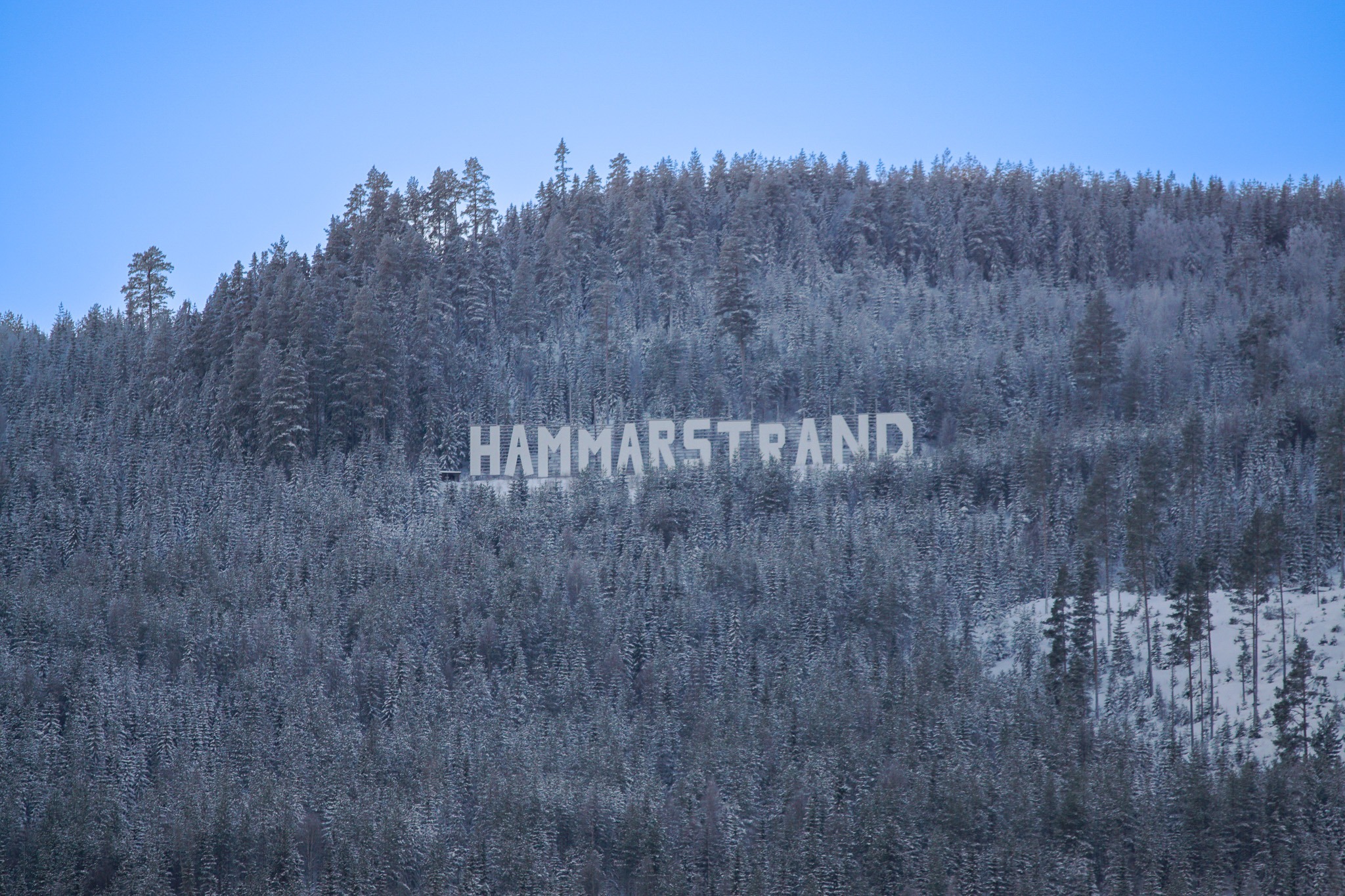
You don’t have to go to Los Angeles for that iconic hillside photo! High above the village, the name HAMMARSTRAND shines in giant white letters against the slopes of Kullstaberget.
The sign was unveiled in 2007 as part of a TV show called Allt för byn (Everything for the Village). The local sentiment was simple: “If Hollywood has a sign, so should we.” Spanning 68 meters long with 8-meter-high letters, it is the largest sign of its kind in Europe.
For visitors, it’s the ultimate selfie spot. With the sign behind you and the winding Indalsälven river below, you’ll have instant proof that you’ve visited the sporting heart of the Ragunda Valley.